[ Longevity research ]
NAD+ in Australia: a cellular-cofactor research guide
What NAD+ is — the cellular cofactor referenced across sirtuin-pathway, mitochondrial and cellular-ageing research — where it sits in the literature, why it comes in 100mg and 500mg vials, and how research-grade material is HPLC-verified. A laboratory research reference for Australian researchers.
7 min read · Updated 22 July 2026
[ Research use only · Not for human consumption ]
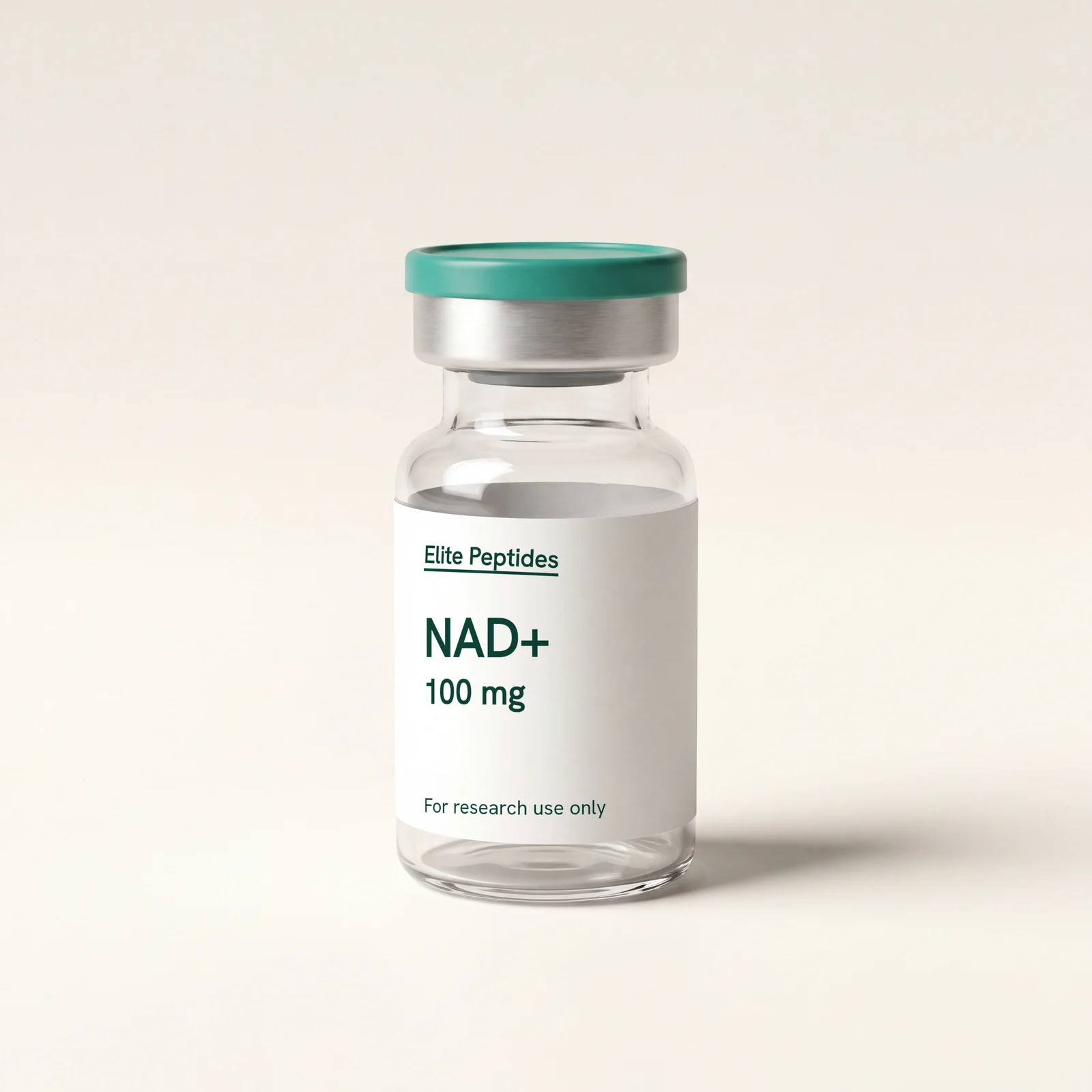
NAD+ in Australia. NAD+ (nicotinamide adenine dinucleotide) is a coenzyme present in every living cell — a cellular-cofactor research compound referenced across sirtuin-pathway, mitochondrial-NAD+ and cellular-ageing research literature. Although catalogued alongside the research peptides, it is technically a dinucleotide, so it carries no amino-acid sequence. This guide is a research-reference summary for Australian researchers; it makes no anti-ageing, longevity-outcome, or human-use claim.
What NAD+ is
NAD+ is a central cofactor in cellular redox biology — the electron carrier that shuttles between its oxidised (NAD+) and reduced (NADH) forms in metabolism. In research it is studied less as a receptor ligand and more as a metabolic cofactor whose availability influences the activity of NAD+-consuming enzymes, principally the sirtuins and the PARPs. That cofactor role is why it sits in the longevity strand of the catalogue rather than among the receptor-targeted peptides.
Sirtuin-pathway and cellular-ageing research
NAD+’s role linking cellular metabolism, sirtuin and PARP activity, and age-related decline is surveyed authoritatively by Verdin (Science, 2015). The biosynthesis and salvage pathways, and the mechanistic basis by which NAD+ availability modulates sirtuin-dependent metabolic and mitochondrial function, are reviewed by Rajman and colleagues (Cell Metabolism, 2018). In pathway research NAD+ is referenced as a cofactor for the sirtuin (SIRT1, SIRT3 and related) enzymes, converging with mitochondrial-NAD+ and cellular-ageing research — as an in-vitro research tool, not a treatment.
NAD+ alongside MOTS-c and SS-31
Within the longevity category NAD+ is most-cited alongside MOTS-c (a mitochondrial-derived peptide) and SS-31 (a mitochondrial-membrane-targeting tetrapeptide). The three interrogate mitochondrial and cellular-ageing biology by different routes — cofactor availability, a genome-encoded peptide, and membrane targeting. The MOTS-c vs NAD+ comparison draws out the peptide-versus-cofactor distinction, and the SS-31 guide covers the membrane-targeting tool.
Two strengths, and why NAD+ needs light protection
NAD+ is stocked in 100mg and 500mg lyophilised vials — the 500mg vial the larger-batch workhorse most-cited across published protocols, the 100mg the lower-volume entry strength. NAD+ is light-sensitive, so research protocols typically note the light-protection step explicitly: store the lyophilised powder at −20°C protected from light, and once reconstituted with bacteriostatic water refrigerate at 2–8°C and use within the documented research window.
Identity, purity and compliance
Every batch of NAD+ is independently HPLC-tested by Janoshik before it is listed, with the certificate published on the product page and in the lab-reports library — real batch number, measured percentage, independently verifiable at janoshik.com. NAD+ is not TGA-approved and is not a therapeutic good; Elite AU Peptides makes no anti-ageing, longevity-outcome, or human-use claim, and supplies it strictly for in-vitro and laboratory research use only.
[ Frequently asked ]
Longevity research — questions researchers ask.
- What is NAD+?
- NAD+ (nicotinamide adenine dinucleotide) is a coenzyme present in every living cell — a cellular-cofactor research compound referenced across sirtuin-pathway, mitochondrial-NAD+ and cellular-ageing research literature. Technically a dinucleotide rather than a peptide, it carries no amino-acid sequence. Elite AU Peptides supplies it strictly for in-vitro and laboratory research use only — not for human or animal consumption, not a therapeutic good, and not TGA-approved. No anti-ageing or longevity-outcome claim is made about it.
- What research is NAD+ associated with?
- NAD+'s role linking cellular metabolism, sirtuin and PARP activity, and age-related decline is surveyed authoritatively by Verdin (Science, 2015). The biosynthesis and salvage pathways, and the mechanistic basis by which NAD+ precursors modulate sirtuin-dependent metabolic and mitochondrial function, are reviewed by Rajman and colleagues (Cell Metabolism, 2018). It is studied in vitro as a cofactor-research compound, not as a treatment.
- Why are 100mg and 500mg vials offered?
- The 500mg vial is the larger-batch research workhorse most-cited across published protocols; the 100mg vial is the lower-volume entry strength. Pricing per vial reflects the strength — the 500mg vial is the better $/mg value for sustained research use.
- How is NAD+ different from MOTS-c and SS-31?
- All three sit in the mitochondrial / longevity research strand but act differently: NAD+ is a cofactor for sirtuin-pathway research; MOTS-c is a genome-encoded mitochondrial-derived peptide studied around AMPK signalling; SS-31 is a synthetic tetrapeptide that targets the inner mitochondrial membrane via cardiolipin binding. See the MOTS-c vs NAD+ comparison for the peptide-versus-cofactor distinction.
- How is research-grade NAD+ tested and stored?
- Every batch is independently HPLC-tested by Janoshik Analytical before it is listed, with the certificate published on the product page and in the lab-reports library. NAD+ is light-sensitive — store the lyophilised powder at −20°C protected from light; once reconstituted with bacteriostatic water, refrigerate at 2–8°C and use within the documented research window.
- How is NAD+ shipped in Australia?
- Stock is held and dispatched AU-domestic — no inbound customs handling. Free shipping over $100; orders placed before 12pm AEST are dispatched the same business day. Supplied strictly for laboratory research use only.
[ Referenced in this guide ]
Shop the compounds
- NAD+ — 100mg / 500mgThe research-grade vial this guide references — independently HPLC-tested, COA on file, AUD pricing.
- MOTS-c — 10mg / 20mg / 40mgThe mitochondrial-derived peptide frequently referenced alongside NAD+.
- SS-31 — 10mgThe mitochondrial-membrane-targeting tetrapeptide in the same longevity category.
Comparing suppliers? Peptide prices in Australia lists what every compound and vial size costs in AUD, read live from the catalogue, next to the batch certificate for each one.
[ Keep reading ]
More research guides
- SS-31 mitochondrial research guideThe mitochondrial-membrane-targeting tetrapeptide in the longevity strand.
- MOTS-c vs NAD+ research comparisonGenome-encoded peptide versus cellular cofactor — how the two differ.
- Epithalon telomere research guideThe pineal tetrapeptide in the same longevity category.
- Longevity & Anti-aging research peptidesThe catalogue category NAD+ is filed under.
- All research guidesBrowse every research-use guide in the library.
Elite AU Peptides supplies research peptides and related compounds for laboratory and in-vitro research use only. Products are not therapeutic goods, are not TGA-approved, and are not for human or animal consumption. Nothing on this site constitutes medical advice or a therapeutic claim. Purchasers must be 18 years or older and are responsible for complying with all applicable laws in their jurisdiction.