[ Longevity research ]
Epithalon in Australia: a telomere-biology research guide
What Epithalon (Epitalon) is — the Ala-Glu-Asp-Gly pineal tetrapeptide referenced across telomere-biology and cellular-ageing research — where it sits in the literature, and how research-grade material is HPLC-verified. A laboratory research reference for Australian researchers.
7 min read · Updated 22 July 2026
[ Research use only · Not for human consumption ]
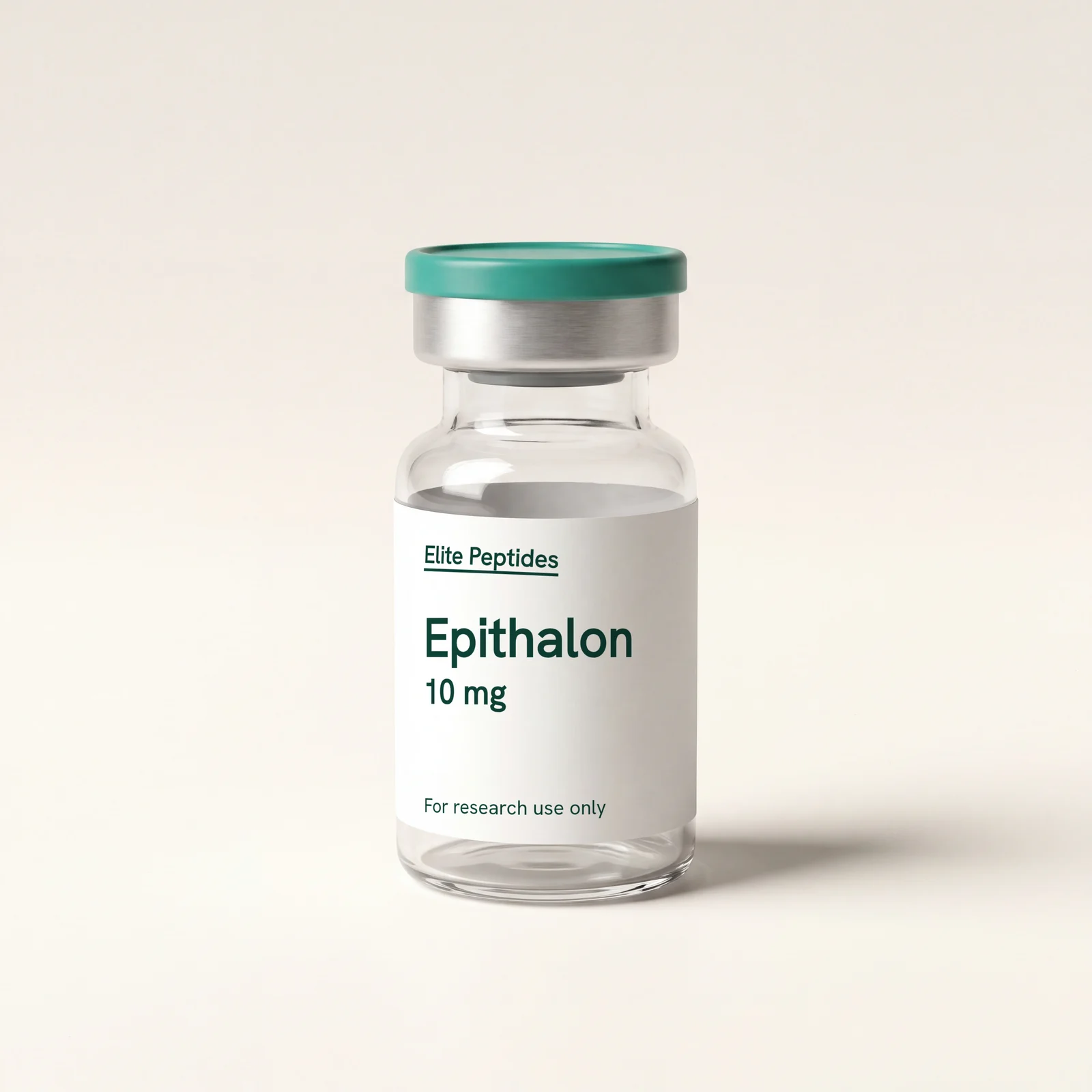
Epithalon in Australia. Epithalon (also written Epitalon) is a synthetic tetrapeptide — Ala-Glu-Asp-Gly (AEDG) — a pineal-peptide bioregulator referenced across telomere-biology and cellular-ageing research literature. This guide is a research-reference summary for Australian researchers. It makes no anti-ageing, longevity-outcome, or human-use claim.
What Epithalon is
Epithalon is a short synthetic “peptide bioregulator” modelled on the pineal polypeptide preparation epithalamin, developed within the peptide-bioregulator research programme associated with Khavinson and colleagues. The two spellings — “Epithalon” and “Epitalon” — refer to the same Ala-Glu-Asp-Gly (AEDG) tetrapeptide; the product page and certificate use the identical molecule regardless of spelling.
Telomere-biology and cellular-ageing research
In cellular-ageing research, Epithalon is studied primarily for reported effects on telomerase (hTERT) expression and telomere length in cultured human somatic cells — the finding first reported by Khavinson and colleagues (Bulletin of Experimental Biology and Medicine, 2003), who described induction of telomerase activity and telomere elongation in human fibroblasts. In-vivo ageing-biomarker work by Anisimov and colleagues (Biogerontology, 2003) examined the peptide against markers of ageing in rodent models. A recent comprehensive peer-reviewed review (Araj and colleagues, International Journal of Molecular Sciences, 2025) surveys twenty-five years of work and notes the precise molecular mechanism remains an open research question.
A model tetrapeptide, not a single-receptor ligand
Because it carries no receptor of its own, Epithalon is used less as a selective ligand and more as a small, well-defined model tetrapeptide for probing telomere-maintenance and gene-regulation questions in cell-culture research. The Ala-Glu-Asp-Gly motif recurs across a body of work examining peptide effects on gene expression in cultured cells, which is what makes it a practical reference compound in that strand of the literature.
Epithalon in the longevity strand
Within the catalogue, Epithalon sits in the longevity & anti-ageing research category alongside NAD+ (a cellular cofactor referenced in sirtuin-pathway research) and MOTS-c (a mitochondrial-derived peptide). Researchers working across the cellular-ageing literature frequently reference these compounds together; the MOTS-c research guide covers the mitochondrial side.
Identity, purity and handling
Every batch of Epithalon is independently HPLC-tested by Janoshik before it is listed, with the certificate published on the product page and in the lab-reports library. As a small, highly polar tetrapeptide it is freely water-soluble; reconstitute with bacteriostatic water (a 10mg vial in 2mL yields a 5mg/mL working stock), store the powder at −20°C and, once reconstituted, at 2–8°C within the documented research window. Epithalon is not TGA-approved and is not a therapeutic good — supplied strictly for in-vitro and laboratory research use only.
[ Frequently asked ]
Longevity research — questions researchers ask.
- What is Epithalon?
- Epithalon (also written Epitalon) is a synthetic tetrapeptide — Ala-Glu-Asp-Gly (AEDG) — a pineal-peptide bioregulator referenced across telomere-biology and cellular-ageing research literature. Elite AU Peptides supplies it strictly for in-vitro and laboratory research use only — not for human or animal consumption, not a therapeutic good, and not TGA-approved. No anti-ageing or longevity-outcome claim is made about it.
- Is Epithalon the same as Epitalon?
- Yes — “Epithalon” and “Epitalon” are two spellings of the same Ala-Glu-Asp-Gly (AEDG) tetrapeptide. Both refer to the identical compound; the product page and certificate use the same molecule regardless of spelling.
- What research is Epithalon associated with?
- In cellular-ageing research, Epithalon is studied primarily for reported effects on telomerase (hTERT) expression and telomere length in cultured human somatic cells — first reported by Khavinson and colleagues (Bulletin of Experimental Biology and Medicine, 2003). In-vivo ageing-biomarker work was reported by Anisimov and colleagues (Biogerontology, 2003). A recent comprehensive review (Araj and colleagues, International Journal of Molecular Sciences, 2025) surveys twenty-five years of work and notes the precise molecular mechanism remains an open research question.
- Does Epithalon act on a specific receptor?
- It carries no receptor of its own — Epithalon is used less as a selective ligand and more as a small, well-defined model tetrapeptide for probing telomere-maintenance and gene-regulation questions in cell-culture research. The Ala-Glu-Asp-Gly motif recurs across a body of peptide-bioregulator work.
- How is research-grade Epithalon tested?
- Every batch is independently HPLC-tested by Janoshik Analytical before it is listed. The measured purity is published on the product page and in the lab-reports library — a real batch number, the measured percentage, and an independently verifiable Janoshik report; nothing is listed without a certificate on file.
- How is Epithalon reconstituted and stored for research use?
- As a small, highly polar tetrapeptide it is freely water-soluble. Reconstitute with bacteriostatic water — for example, a 10mg vial in 2mL yields a 5mg/mL working stock. Store the lyophilised powder at −20°C protected from light; once reconstituted, refrigerate at 2–8°C and use within the documented research window.
- How is Epithalon shipped in Australia?
- Stock is held and dispatched AU-domestic — no inbound customs handling. Free shipping over $100; orders placed before 12pm AEST are dispatched the same business day. Supplied strictly for laboratory research use only.
[ Referenced in this guide ]
Shop the compounds
- Epithalon — 10mgThe research-grade vial this guide references — independently HPLC-tested, COA on file, AUD pricing.
- NAD+ — 100mg / 500mgThe flagship cellular-cofactor research compound in the longevity category.
- MOTS-c — 10mg / 20mg / 40mgThe mitochondrial-derived peptide in the same longevity category.
Comparing suppliers? Peptide prices in Australia lists what every compound and vial size costs in AUD, read live from the catalogue, next to the batch certificate for each one.
[ Keep reading ]
More research guides
- MOTS-c mitochondrial research guideThe adjacent mitochondrial-research peptide in the longevity strand.
- DSIP delta-sleep research guideAn adjacent short-peptide neuromodulation research compound.
- Longevity & Anti-aging research peptidesThe catalogue category Epithalon is filed under.
- All research guidesBrowse every research-use guide in the library.
Elite AU Peptides supplies research peptides and related compounds for laboratory and in-vitro research use only. Products are not therapeutic goods, are not TGA-approved, and are not for human or animal consumption. Nothing on this site constitutes medical advice or a therapeutic claim. Purchasers must be 18 years or older and are responsible for complying with all applicable laws in their jurisdiction.