Rated 5 out of 5.Verified purchase
Ordered the 3ml bac water vials as a top-up. Arrived in two days, packed just as carefully as the peptides were. Small order treated properly.
Shipping 5/5Would recommend
Free shipping Australia-wide on orders over $100
Free shipping over $100 · same-day dispatch before 12pm AEST · Australia only.
Supplied strictly for in-vitro / laboratory research use only. Not for human or animal consumption. You confirm you are 18+ and purchasing for research purposes.
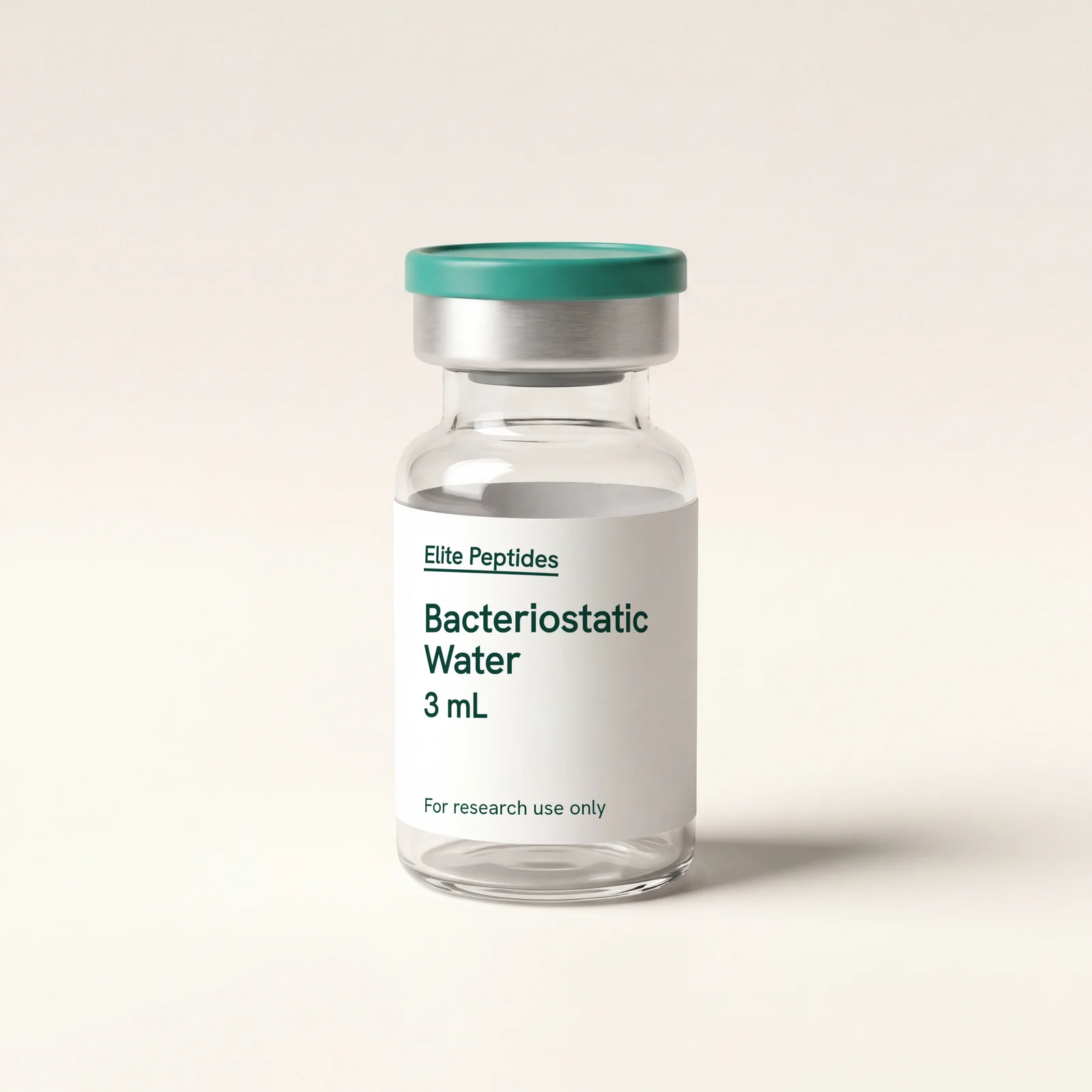
Bacteriostatic Water Australia. This is the liquid used to turn a freeze-dried peptide back into a solution. It is not a research compound itself, so there is no outcome to report. The practical difference it makes is the multi draw window: one vial can be drawn from repeatedly over the life of a protocol instead of being discarded after first access.
How it does it. Bacteriostatic water is sterile water with 0.9% benzyl alcohol added as a preservative. Plain sterile water stops being sterile the moment a needle goes into it. The benzyl alcohol holds bacterial growth down, which is why this, and not plain water, is the diluent named on every freeze-dried product in the catalogue. The 3 mL vial suits a single compound, the 10 mL suits a bench working through several.
The vial. Sterile solutions are held to a sterility and endotoxin standard rather than an HPLC purity figure, which is the relevant assurance for a diluent rather than a research compound. Supplied in 3 mL and 10 mL vials, dispatched from Australia, AUD pricing. Supplied strictly for in-vitro and laboratory research use only. Not for human or animal consumption, not a therapeutic good, not TGA-approved.
Buying bac water in Australia. Bacteriostatic water is not a general retail line, so it is not something you pick off the shelf at Chemist Warehouse or another pharmacy chain. What is stocked here is research-grade bacteriostatic water, held in Australia and dispatched domestically, so there is no international leg and no customs step: AUD pricing, free shipping over $100, and same day dispatch on orders placed before 12pm AEST. It is supplied for in-vitro and laboratory research use only. It is not a pharmacy product and not a therapeutic good.
Also known as bac water. Bac water is the shorthand for bacteriostatic water, the multi dose diluent vial. It is the same sterile 0.9% benzyl alcohol solution in either a 3ml or a 10ml vial, used to bring freeze-dried research peptides back into solution.
Bacteriostatic water is water to which 0.9% (w/v) benzyl alcohol has been added as an antimicrobial preservative. In peptide-research methodology it is the standard diluent used to reconstitute lyophilised research peptides into a working stock; the benzyl alcohol concentration is the methodological reference value across the peptide-research literature.
The advantage over plain sterile water is the multi-access window: the benzyl alcohol inhibits microbial growth, so the same vial can be drawn from across a multi-step research protocol, whereas single-use sterile water loses its sterility guarantee after first access. That property is why bacteriostatic water — not sterile water or plain water — is the diluent named in the Reconstitution accordion of every lyophilised compound in this catalogue. It is also what “multi dose vial” means on a diluent label: the preservative, not the closure, is what makes repeated access workable.
It is worth separating bacteriostatic water from the three solutions it is most often confused with. Sterile water is the same water without the preservative, so it is single-access. Sodium chloride 0.9% (saline) is isotonic and carries no preservative, and is a different reagent with different handling. Water for irrigation is not a reconstitution diluent at all. For lyophilised research peptides the diluent named across the methodology literature is bacteriostatic water, which is why every Reconstitution section in this catalogue names it specifically.
3 ml or 10 ml. The choice is arithmetic rather than preference: the vial volume is the total diluent it can supply. A 3 ml vial covers a single compound reconstituted at a typical working volume, and a 10 ml vial covers a bench running several in parallel — reconstituting five 10 mg vials at 2 mL each consumes exactly 10 mL. Because a preserved vial is drawn from across a protocol rather than discarded after first access, the larger volume is usually the lower cost per reconstitution.
Bacteriostatic water is the reference diluent for the catalogue across the GLP-class, healing & recovery, longevity, nootropic and stack categories. Because it is a diluent and not a research compound, it carries no CAS-based purity figure; the relevant quality signal is the sterility / endotoxin standard the sterile-solution batch is held to, documented on the batch label. That is the correct assurance for a solution: an HPLC purity percentage describes a peptide, and there is no peptide here to describe.
Bacteriostatic water is not a therapeutic good and is not TGA-approved. It is supplied strictly for in-vitro and laboratory research use only — not for human or animal consumption.
Bacteriostatic water is itself the reconstitution diluent — it does not require reconstitution. Draw the required volume into a sterile transfer syringe using standard laboratory aseptic technique — wipe the stopper, and avoid touching the needle to non-sterile surfaces — then add it slowly down the wall of the lyophilised vial of the target research peptide and swirl gently rather than shaking.
The volume drawn is what sets the working-stock concentration, so it is decided by the concentration the protocol calls for rather than by the vial. Peptide mass divided by diluent volume gives the result: a 10 mg vial in 2 mL of bac water is a 5 mg/mL stock, and the same vial in 5 mL is 2 mg/mL. Record the volume used against the batch number on the label, because the concentration cannot be recovered from the solution afterwards.
Store at room temperature, away from direct light. Do not freeze the diluent. The batch label documents the per-vial volume and the preservative concentration; because of the bacteriostatic preservative, the same vial can be referenced across a multi-step research protocol within the documented research window from first access. Once a research peptide has been reconstituted, that solution is the thing that needs refrigeration at 2–8°C, not the unopened diluent.
Australia only. Free shipping over $100. Orders placed before 12pm AEST are dispatched the same business day from Australia.
30-day returns on unused product in original packaging, with prior approval.
[ Further reading ]
How to reconstitute research peptides: method + calculatorHow to reconstitute a lyophilised research peptide with bacteriostatic water — the method, the concentration math, and an interactive calculator that reads off the working-stock concentration. A laboratory research reference for Australian researchers.
[ Certificate of analysis ]
— The batch certificate and downloadable scan for Bacteriostatic Water are published on the lab-reports page and confirmed at catalogue load.
Janoshik · HPLC
≥ 99%
brand standard · independently verified
[ Customer reviews ]
5.0
Average rating 5 out of 5, from 2 reviews
Ordered the 3ml bac water vials as a top-up. Arrived in two days, packed just as carefully as the peptides were. Small order treated properly.
Grabbed a few of the 10ml bac water vials with my order. Cheap, arrived fast, no dramas.
Compare this against every other vial on the peptide prices page, browse ancillaries, or see all 23 research peptides.
Elite AU Peptides supplies research peptides and related compounds for laboratory and in-vitro research use only. Products are not therapeutic goods, are not TGA-approved, and are not for human or animal consumption. Nothing on this site constitutes medical advice or a therapeutic claim. Purchasers must be 18 years or older and are responsible for complying with all applicable laws in their jurisdiction.