[ Mitochondrial research ]
MOTS-c in Australia: a mitochondrial-derived-peptide research guide
What MOTS-c is — a 16-residue mitochondrial-derived peptide encoded within the mitochondrial 12S rRNA — where it sits in AMPK-pathway and mitochondrial-stress research, how it is referenced alongside NAD+ and SS-31, and how research-grade material is HPLC-verified. A laboratory research reference for Australian researchers.
8 min read · Updated 22 July 2026
[ Research use only · Not for human consumption ]
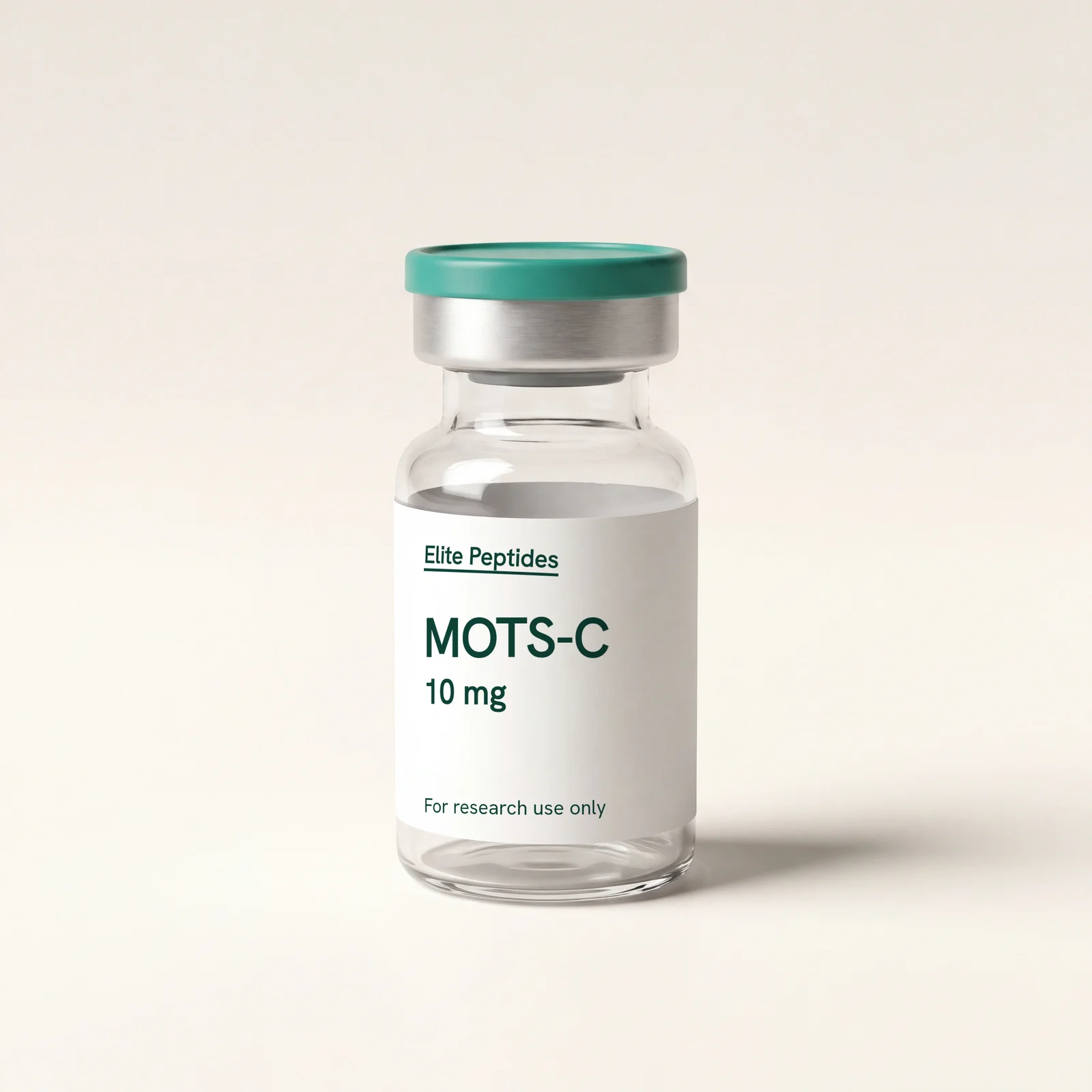
MOTS-c in Australia. MOTS-c is a 16-amino-acid mitochondrial-derived peptide (MDP) — encoded within the 12S rRNA region of the mitochondrial genome and one of the better-characterised members of the MDP class. It is referenced across mitochondrial-stress, metabolic and cellular-senescence research literature. This guide is a research-reference summary for Australian researchers; it makes no medical, therapeutic, anti-ageing, or human-use claim, and in particular no weight-loss claim.
What a mitochondrial-derived peptide is
Most cellular peptides are encoded in the nuclear genome. Mitochondrial-derived peptides are the exception — short peptides encoded within the mitochondrial genome itself. The class includes humanin and the SHLPs; MOTS-c (Mitochondrial Open reading frame of the Twelve S rRNA-c) is the member most-studied in metabolic and AMPK-pathway research. Understanding MOTS-c as genome-encoded rather than synthetic-by-design is what places it in a distinct research strand from the synthetic mitochondrial-targeting peptides such as SS-31.
AMPK-pathway and mitochondrial-stress research
MOTS-c was identified and characterised by Lee and colleagues (Cell Metabolism, 2015), who described the peptide, its mitochondrial origin, and its role in the folate–methionine (AICAR) pathway leading to AMP-activated protein kinase (AMPK) activation and metabolic-homeostasis research readouts. Later work by Reynolds and colleagues (Nature Communications, 2021) reported MOTS-c as an exercise-responsive, mitochondrially-encoded regulator that translocates to the nucleus to influence stress-adaptive and metabolic gene programmes in research models. These two studies anchor MOTS-c as a reference peptide for AMPK-pathway and mitochondrial-stress research — a research tool, not a treatment.
MOTS-c alongside NAD+ and SS-31
Within the longevity strand of the catalogue, MOTS-c is frequently referenced alongside NAD+ (a cofactor for sirtuin-pathway research) and SS-31 (a mitochondrial-membrane-targeting tetrapeptide). Researchers compare the three because they interrogate mitochondrial biology by different routes: MOTS-c through a genome-encoded AMPK-linked peptide, NAD+ through cofactor availability, and SS-31 through cardiolipin-binding membrane targeting. The parallels — and the metabolic-research overlap with the growth-hormone-secretagogue compounds — are why MOTS-c sits near the CJC-1295 GHRH research guide in the mesh.
Identity, purity and the COA moat
Every batch of MOTS-c supplied by Elite AU Peptides is independently HPLC-tested by Janoshik before it is listed. The measured purity is published on the MOTS-c product page and in the lab-reports library — real batch number, measured percentage, independently verifiable at janoshik.com. MOTS-c is stocked in 10mg, 20mg and 40mg lyophilised vials; nothing is listed without a certificate on file.
Reconstitution and handling for research use
MOTS-c ships as a lyophilised powder. Reconstitute with bacteriostatic water for laboratory handling — for example, a 10mg vial in 2mL yields a 5mg/mL working stock; adjust to the concentration your assay requires. Store the lyophilised powder at −20°C protected from light; once reconstituted, refrigerate at 2–8°C and use within the documented research window, or aliquot and freeze to avoid repeated freeze-thaw cycles.
Compliance and research-use framing
MOTS-c is not TGA-approved and is not a therapeutic good. Elite AU Peptides supplies it strictly for in-vitro and laboratory research use only — not for human or animal consumption. We make no medical, therapeutic, anti-ageing, longevity-outcome, weight-loss, or human-use claim; the material above summarises the published mitochondrial-derived-peptide literature for reference only. Researchers should consult primary peer-reviewed sources for pathway data and protocol-specific reference values.
[ Frequently asked ]
Mitochondrial research — questions researchers ask.
- What is MOTS-c?
- MOTS-c is a 16-amino-acid mitochondrial-derived peptide (MDP) encoded within the 12S rRNA region of the mitochondrial genome — its name stands for Mitochondrial Open reading frame of the Twelve S rRNA-c. It is referenced across mitochondrial-stress, metabolic-research and cellular-senescence research literature. Elite AU Peptides supplies it strictly for in-vitro and laboratory research use only — not for human or animal consumption, not a therapeutic good, and not TGA-approved.
- What research is MOTS-c associated with?
- MOTS-c was identified and characterised by Lee and colleagues (Cell Metabolism, 2015), who described its mitochondrial origin and its role in the folate–methionine (AICAR) pathway leading to AMP-activated protein kinase (AMPK) activation. Later work by Reynolds and colleagues (Nature Communications, 2021) reported it as an exercise-responsive, mitochondrially-encoded regulator that translocates to the nucleus to influence stress-adaptive gene programmes in research models. It is studied in vitro as a research tool, not as a treatment.
- What is a mitochondrial-derived peptide?
- Mitochondrial-derived peptides (MDPs) are small peptides encoded within the mitochondrial genome rather than the nuclear genome — the class includes humanin, the SHLPs, and MOTS-c. MOTS-c is one of the better-characterised members and is referenced as a research reference peptide for the AMPK-pathway and mitochondrial-stress strands of the literature.
- How is MOTS-c different from NAD+ and SS-31?
- All three sit in the mitochondrial-research strand of the longevity category but act differently: MOTS-c is a genome-encoded mitochondrial-derived peptide studied around AMPK signalling; NAD+ is a cellular cofactor referenced in sirtuin-pathway research; SS-31 is a synthetic tetrapeptide that targets the inner mitochondrial membrane via cardiolipin binding. Researchers frequently compare these mitochondrial-research tools within a single protocol.
- How is research-grade MOTS-c tested?
- Every batch of MOTS-c is independently HPLC-tested by Janoshik Analytical before it is listed. The measured purity is published on the product page and in the lab-reports library — a real batch number, the measured percentage, and an independently verifiable Janoshik report; nothing is listed without a certificate on file.
- How is MOTS-c reconstituted and stored for research use?
- The lyophilised vial is reconstituted with bacteriostatic water for laboratory handling — for example, a 10mg vial in 2mL yields a 5mg/mL working stock. Store the lyophilised powder at −20°C protected from light; once reconstituted, refrigerate at 2–8°C and use within the documented research window. Consult primary literature for protocol-specific reference values.
- How is MOTS-c shipped in Australia?
- Stock is held and dispatched AU-domestic — no inbound customs handling. Free shipping over $100; orders placed before 12pm AEST are dispatched the same business day. Supplied strictly for laboratory research use only.
[ Referenced in this guide ]
Shop the compounds
- MOTS-c — 10mg / 20mg / 40mgThe research-grade vial this guide references — independently HPLC-tested, COA on file, AUD pricing.
- NAD+ — 100mg / 500mgThe cofactor MOTS-c is frequently referenced alongside in mitochondrial and cellular-ageing research.
- SS-31 — 10mgThe mitochondrial-membrane-targeting tetrapeptide — the other mitochondrial-research tool in the catalogue.
Comparing suppliers? Peptide prices in Australia lists what every compound and vial size costs in AUD, read live from the catalogue, next to the batch certificate for each one.
[ Keep reading ]
More research guides
- Epithalon telomere research guideThe adjacent longevity / cellular-ageing research peptide.
- AOD-9604 research guideThe adjacent metabolic / lipid-pathway research compound.
- CJC-1295 GHRH research guideThe adjacent growth-hormone-secretagogue research compound.
- Longevity & Anti-aging research peptidesThe catalogue category MOTS-c is filed under.
- All research guidesBrowse every research-use guide in the library.
Elite AU Peptides supplies research peptides and related compounds for laboratory and in-vitro research use only. Products are not therapeutic goods, are not TGA-approved, and are not for human or animal consumption. Nothing on this site constitutes medical advice or a therapeutic claim. Purchasers must be 18 years or older and are responsible for complying with all applicable laws in their jurisdiction.