[ Metabolic-pathway research ]
AOD-9604 in Australia: a growth-hormone-fragment research guide
What AOD-9604 is — a synthetic fragment of the C-terminal domain of human growth hormone — where it sits in lipid-metabolism-pathway research, and how research-grade material is HPLC-verified. Receptor/pathway framing only; a laboratory research reference for Australian researchers.
7 min read · Updated 22 July 2026
[ Research use only · Not for human consumption ]
AOD-9604 in Australia. AOD-9604 is a synthetic peptide studied in laboratory research as a modified fragment of the C-terminal lipolytic domain of human growth hormone — the hGH(177-191) sequence with an added N-terminal tyrosine. This guide is a research-reference summary for Australian researchers, framed strictly around lipid-metabolism-pathway research. It makes no fat-loss, weight-loss, body-composition, or human-use claim.
What AOD-9604 is
AOD-9604 is a 16-residue synthetic peptide — the sequence Tyr-hGH(177-191). It corresponds to the C-terminal lipolytic fragment of the human growth-hormone molecule, with an added N-terminal tyrosine; an intramolecular disulfide bridge between its two cysteine residues forms a small loop that mirrors the native hGH C-terminal loop. It is a distinct research entity from the intact 191-residue hormone — a defined synthetic fragment rather than the whole molecule.
The lipid-metabolism pathway it probes
In receptor and pathway research, AOD-9604 is studied as a probe of the growth-hormone lipolytic pathway that is structurally separable from the somatogenic, IGF-1-mediated actions of the intact hormone. The original metabolic characterisation of the synthetic fragment was reported by Ng and colleagues (Hormone Research, 2000); Heffernan and colleagues (Endocrinology, 2001) used β3-adrenergic-receptor knock-out models to probe the pathway implicated in the fragment’s lipid-metabolic signalling — the reason the β3-adrenergic receptor is referenced across AOD-9604 research literature. It is studied in vitro as a research tool, not as a treatment.
A defined fragment makes a convenient reference compound
Because the peptide is a defined synthetic fragment, it is also studied as an analytical reference: Cox and colleagues (Drug Testing and Analysis, 2015) characterised its detection and in-vitro metabolic breakdown products. As a short, defined sequence it reconstitutes and stores predictably, which is why it is used to study the lipid-metabolic signal in isolation from the hormone’s receptor-mediated growth axis, rather than as a probe of the intact hormone.
Not a fat-loss compound — the framing matters
AOD-9604 is framed here strictly around lipid-metabolism-pathway research in controlled laboratory models. Elite AU Peptides makes no fat-loss, weight-loss, body-composition, or human-use claim about this product. It sits in the GLP-class & metabolic research category alongside retatrutide and tesamorelin; the GLP-1 research peptides pillar covers the wider metabolic-research context.
Identity, purity and compliance
Every batch of AOD-9604 is independently HPLC-tested by Janoshik before it is listed, with the certificate published on the product page and in the lab-reports library — real batch number, measured percentage, independently verifiable at janoshik.com. AOD-9604 is not TGA-approved and is not a therapeutic good; it is supplied strictly for in-vitro and laboratory research use only — not for human or animal consumption. Researchers should consult primary peer-reviewed sources for pathway data and protocol-specific reference values.
[ Frequently asked ]
Metabolic-pathway research — questions researchers ask.
- What is AOD-9604?
- AOD-9604 is a synthetic peptide — a modified fragment of the C-terminal lipolytic domain of human growth hormone (the hGH 177-191 sequence with an added N-terminal tyrosine). It is referenced in lipid-metabolism-pathway research literature. Elite AU Peptides supplies it strictly for in-vitro and laboratory research use only — not for human or animal consumption, not a therapeutic good, and not TGA-approved. We make no fat-loss, weight-loss, or body-composition claim about it.
- What research is AOD-9604 associated with?
- AOD-9604 is studied as a probe of the growth-hormone lipolytic pathway that is structurally separable from the somatogenic, IGF-1-mediated actions of the intact hormone. The original metabolic characterisation was reported by Ng and colleagues (Hormone Research, 2000); Heffernan and colleagues (Endocrinology, 2001) used β3-adrenergic-receptor knock-out models to probe the pathway implicated in its lipid-metabolic signalling. It is studied in vitro as a research tool, not as a treatment.
- How is AOD-9604 different from the intact growth hormone?
- AOD-9604 corresponds only to the C-terminal lipolytic fragment of human growth hormone (with an added N-terminal tyrosine and a stabilising disulfide loop) — a distinct research entity from the intact 191-residue hormone. It is used to study the lipid-metabolic signal in isolation from the hormone's receptor-mediated growth axis, which is why it is a convenient defined reference compound for adipocyte and lipid-metabolism assays.
- Is AOD-9604 a fat-loss or weight-loss compound?
- No such claim is made here. AOD-9604 is framed strictly around lipid-metabolism-pathway research in controlled laboratory models. Elite AU Peptides makes no fat-loss, weight-loss, body-composition, or human-use claim about this product; it is supplied for in-vitro laboratory research use only.
- How is research-grade AOD-9604 tested?
- Every batch is independently HPLC-tested by Janoshik Analytical before it is listed. The measured purity is published on the product page and in the lab-reports library — a real batch number, the measured percentage, and an independently verifiable Janoshik report; nothing is listed without a certificate on file.
- How is AOD-9604 reconstituted and stored for research use?
- The lyophilised vial is reconstituted with bacteriostatic water for laboratory handling — for example, a 5mg vial in 2mL yields a 2.5mg/mL working stock. Store the lyophilised powder at −20°C protected from light; once reconstituted, refrigerate at 2–8°C and use within the documented research window.
- How is AOD-9604 shipped in Australia?
- Stock is held and dispatched AU-domestic — no inbound customs handling. Free shipping over $100; orders placed before 12pm AEST are dispatched the same business day. Supplied strictly for laboratory research use only.
[ Referenced in this guide ]
Shop the compounds
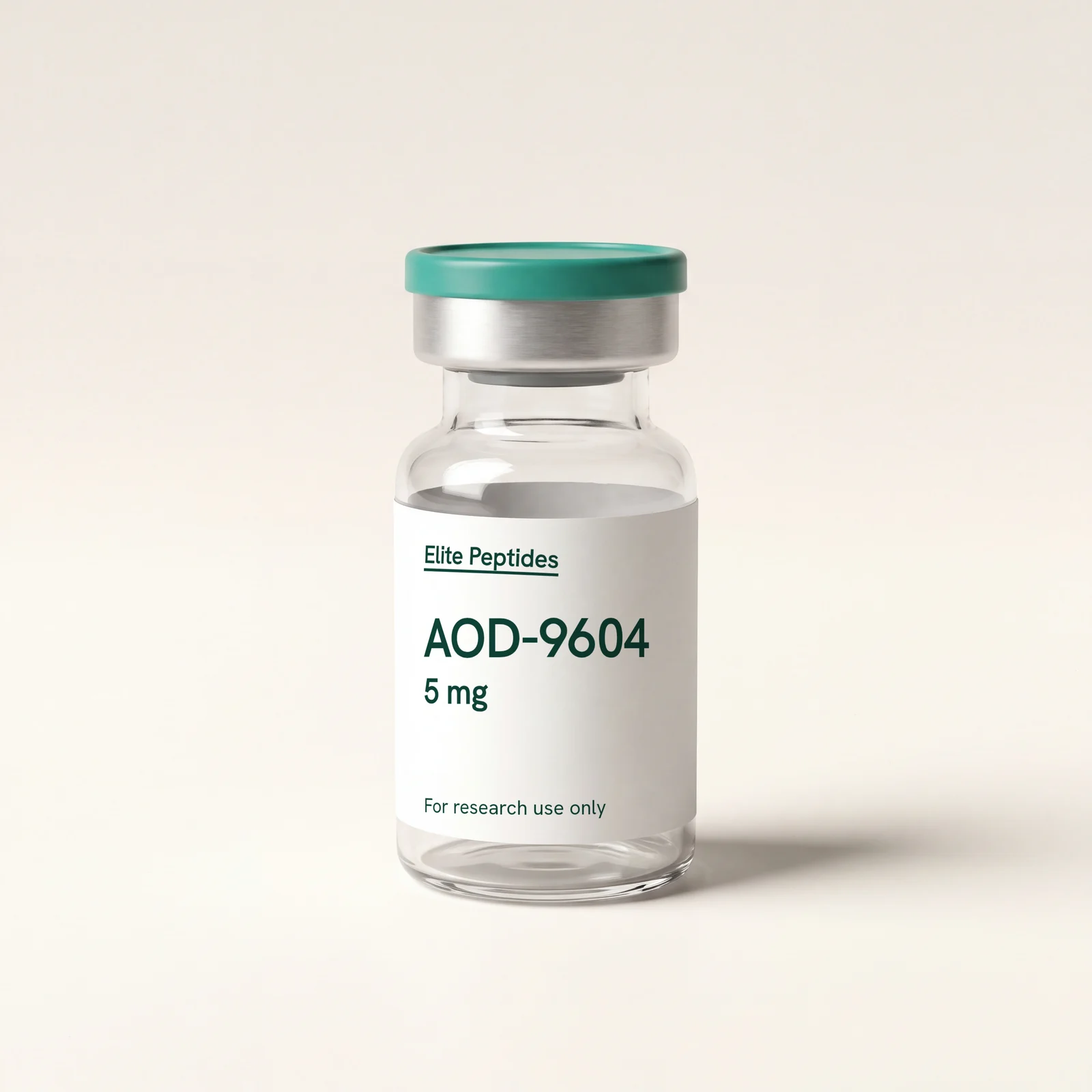
- AOD-9604 — 5mgThe research-grade vial this guide references — independently HPLC-tested, COA on file, AUD pricing.
- Retatrutide — 10mg / 15mg / 20mg / 30mgA GLP-class research peptide in the same metabolic category.
- Tesamorelin — 10mg / 20mgA GHRH-analogue research peptide in the same metabolic category.
Comparing suppliers? Peptide prices in Australia lists what every compound and vial size costs in AUD, read live from the catalogue, next to the batch certificate for each one.
[ Keep reading ]
More research guides
- GLP-1 research peptides explainedThe incretin-research pillar in the same GLP-class / metabolic category.
- MOTS-c mitochondrial research guideAn adjacent metabolic-research compound.
- GLP-class & Metabolic research peptidesThe catalogue category AOD-9604 is filed under.
- All research guidesBrowse every research-use guide in the library.
Elite AU Peptides supplies research peptides and related compounds for laboratory and in-vitro research use only. Products are not therapeutic goods, are not TGA-approved, and are not for human or animal consumption. Nothing on this site constitutes medical advice or a therapeutic claim. Purchasers must be 18 years or older and are responsible for complying with all applicable laws in their jurisdiction.