[ Copper-peptide research ]
GHK-Cu in Australia: a copper-peptide research guide
What GHK-Cu is, its place in copper-binding and matrix-remodelling research, why reconstituted solutions run blue, and how research-grade copper peptide is verified — a laboratory research reference for Australian researchers.
8 min read · Updated 21 July 2026
[ Research use only · Not for human consumption ]
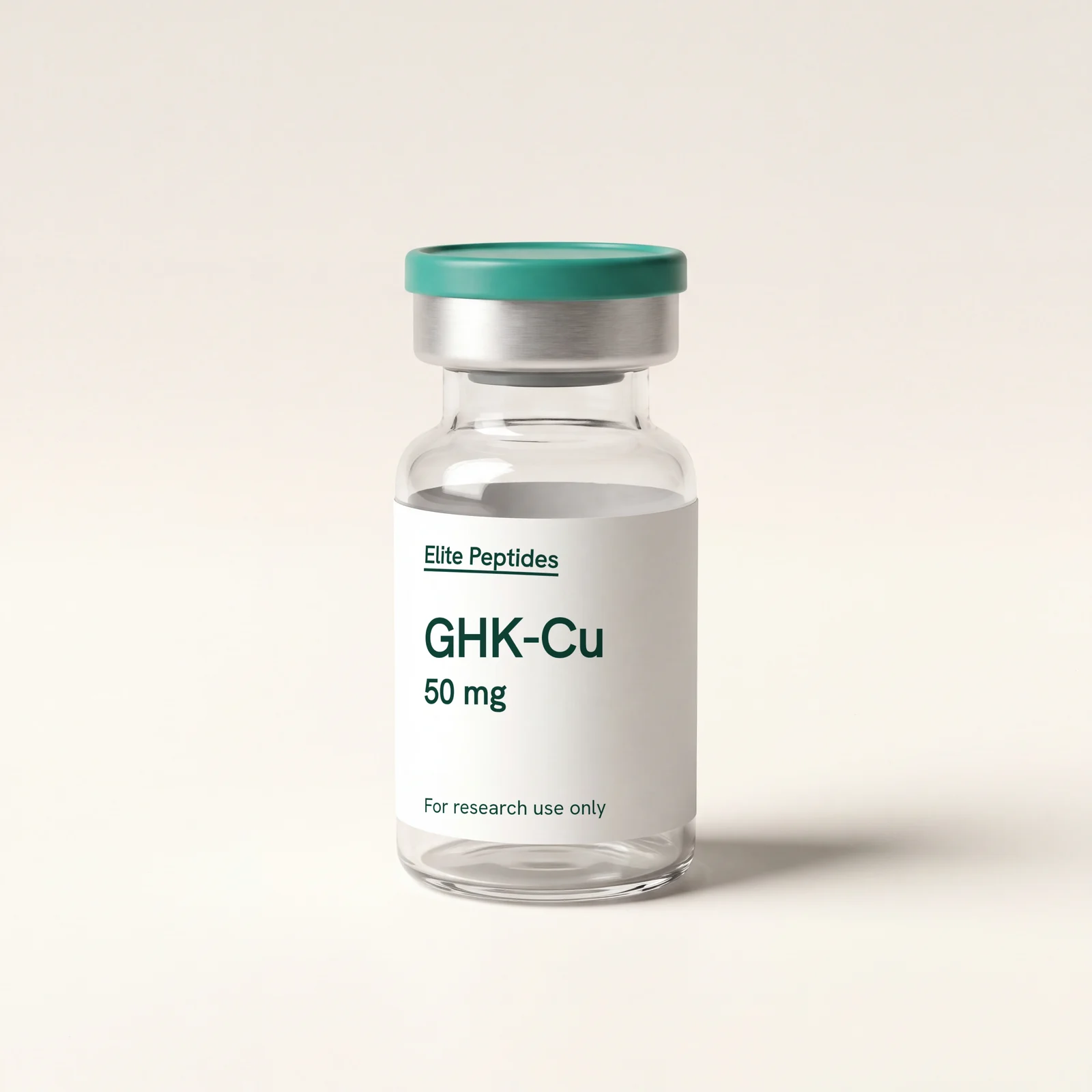
GHK-Cu in Australia. GHK-Cu is a copper-binding tripeptide complex — glycyl-L-histidyl- L-lysine (GHK) bound to a copper(II) ion — referenced across the copper-coordination, matrix-remodelling and dermal research literature. First identified in human plasma research in the 1970s and studied across more than fifty years since, it is the most-researched copper-peptide research compound. This guide is a research- reference summary for Australian researchers; it makes no cosmetic, medical, or human-use claim.
What GHK-Cu actually is
The GHK sequence is a naturally occurring tripeptide first isolated from human plasma. Its defining feature is a high-affinity binding site for copper(II): the histidine imidazole and the terminal amine coordinate a copper ion to form the GHK-Cu complex studied in the literature. The compound is therefore best understood as a metal-peptide complex rather than a simple peptide — its copper-coordination chemistry is central to almost every research model it appears in.
Copper-binding and matrix-remodelling research
GHK-Cu is most frequently cited in three overlapping research strands: copper-coordination chemistry (how the complex binds, delivers and buffers copper in research systems), matrix-remodelling research (its behaviour in in-vitro extracellular-matrix and fibroblast models), and broader dermal / skin-research literature, where it is one of the most-studied copper peptides. Research on the compound centres on these copper-dependent pathways in controlled laboratory models — it is a research tool for studying copper-peptide biology, not a treatment.
Why reconstituted GHK-Cu is blue
A practical hallmark: once reconstituted, GHK-Cu solutions are a characteristic blue. The colour comes directly from the copper(II) coordination chemistry of the complex and is expected — a useful visual batch-consistency marker rather than a defect. Record the colour in your protocol notes; a solution that fails to develop the expected blue on reconstitution is worth flagging against the certificate of analysis.
GHK-Cu is not an ingestible collagen supplement
A common point of confusion worth stating plainly: GHK-Cu is a copper-peptide research compound, not an ingestible “collagen peptide” supplement. The two occupy entirely different categories — ingestible collagen products are consumer supplements, whereas the GHK-Cu supplied here is a research-grade copper-peptide complex for in-vitro laboratory work only. If you arrived searching for a collagen supplement, this is not that product. GHK-Cu is studied for its copper-coordination and matrix-research behaviour in the laboratory, and is supplied for research use only.
Identity, purity and the COA moat
Every batch of GHK-Cu supplied by Elite AU Peptides is independently HPLC-tested by Janoshik before it is listed. The measured purity is published on the GHK-Cu product page and in the lab-reports library — real batch number, measured percentage, independently verifiable at janoshik.com. GHK-Cu is stocked in 50mg and 100mg lyophilised vials at AUD pricing; nothing is listed without a certificate on file.
Reconstitution and handling for research use
GHK-Cu ships as a lyophilised powder. Reconstitute with bacteriostatic water for laboratory handling — for example, a 50mg vial in 10mL yields a 5mg/mL working stock; adjust to the concentration your assay requires. Store the lyophilised powder at −20°C, protected from light; once reconstituted, refrigerate at 2–8°C and use within the documented research window. GHK-Cu is a component of the co-lyophilised GLOW70 research blend (alongside BPC-157 and TB-500) if a combined-vial format suits the protocol.
Compliance and research-use framing
GHK-Cu is not TGA-approved, is not a therapeutic good, and is not a cosmetic ingredient intended for end-use formulation. Elite AU Peptides supplies it strictly for in-vitro and laboratory research use only — not for human or animal consumption. We make no cosmetic, medical, or human-use claim; the material above summarises the published copper-peptide research literature for reference only. Researchers should consult primary peer-reviewed sources for binding constants, assay conditions, and protocol-specific reference values.
[ Frequently asked ]
Copper-peptide research — questions researchers ask.
- What is GHK-Cu?
- GHK-Cu is a copper-binding tripeptide complex — glycyl-L-histidyl-L-lysine bound to a copper(II) ion — first identified in human plasma research. Referenced across more than fifty years of literature, it is the most-researched copper-peptide research compound. Elite AU Peptides supplies it strictly for in-vitro and laboratory research use only.
- Is GHK-Cu a cosmetic or therapeutic good in Australia?
- No. The GHK-Cu supplied here is not TGA-approved, is not a therapeutic good, and is not a cosmetic ingredient intended for end-use formulation. It is supplied strictly for in-vitro and laboratory research use only, with no cosmetic, medical, or human-use claim.
- What research is GHK-Cu associated with?
- GHK-Cu is most frequently cited in copper-coordination chemistry, matrix-remodelling research, and dermal / skin-research literature. Research on the compound centres on its copper-binding behaviour and its role in research models of copper-dependent enzyme systems — studied in vitro, not as a treatment.
- Why does reconstituted GHK-Cu turn blue?
- Once reconstituted, GHK-Cu solutions are characteristically blue — the colour comes from the copper(II) coordination chemistry of the complex. The blue tint is expected and is a useful batch-consistency marker; note the colour in your protocol records.
- How is research-grade GHK-Cu tested?
- Every batch of GHK-Cu is independently HPLC-tested by Janoshik Analytical before listing. The certificate of analysis is published on the product page and in the lab-reports library — real batch number, measured purity, independently verifiable at janoshik.com.
- How much does GHK-Cu cost, and how is it shipped in Australia?
- GHK-Cu is stocked in 50mg and 100mg lyophilised vials at AUD pricing shown on the product page; free shipping applies over $100. Stock is held and dispatched AU-domestic, with same-day dispatch on orders placed before 12pm AEST. Supplied strictly for laboratory research use only.
- How is GHK-Cu reconstituted for research use?
- The lyophilised vial is reconstituted with bacteriostatic water for laboratory handling — for example, a 50mg vial in 10mL yields a 5mg/mL working stock. Store the lyophilised powder at −20°C protected from light; once reconstituted, refrigerate at 2–8°C and use within the documented research window.
[ Referenced in this guide ]
Shop the compounds
- GHK-Cu — 50mg / 100mgBuy research-grade GHK-Cu in Australia — independently HPLC-tested, COA on file, AUD pricing.
- GLOW70 research blendA co-lyophilised blend that pairs GHK-Cu with BPC-157 and TB-500.
- Bacteriostatic water — 3ml / 10mlThe standard reconstitution diluent for lyophilised research peptides.
Comparing suppliers? Peptide prices in Australia lists what every compound and vial size costs in AUD, read live from the catalogue, next to the batch certificate for each one.
[ Keep reading ]
More research guides
- Melanotan 2 melanocortin research guideThe melanocortin-receptor research peptide — the sibling skin-adjacent research guide.
- TB-500 (thymosin β-4) research guideThe soft-tissue-repair research peptide co-formulated with GHK-Cu in the GLOW70 blend.
- PT-141 melanocortin (MC4R) research guideThe melanocortin-pathway research peptide in the adjacent aesthetics & lifestyle category.
- GHK-Cu vs collagen peptidesWhy the copper-peptide research compound is not an ingestible collagen supplement.
- Cosmetic & Skin research peptidesThe catalogue category GHK-Cu is filed under.
- All research guidesBrowse every research-use guide in the library.
Elite AU Peptides supplies research peptides and related compounds for laboratory and in-vitro research use only. Products are not therapeutic goods, are not TGA-approved, and are not for human or animal consumption. Nothing on this site constitutes medical advice or a therapeutic claim. Purchasers must be 18 years or older and are responsible for complying with all applicable laws in their jurisdiction.