[ Healing & recovery research ]
BPC-157 in Australia: a soft-tissue research guide
What BPC-157 is — the 15-residue pentadecapeptide that is the category benchmark across tendon, ligament, gastric-tissue and angiogenesis research — how it is referenced alongside TB-500, and how research-grade material is HPLC-verified. A laboratory research reference for Australian researchers.
8 min read · Updated 22 July 2026
[ Research use only · Not for human consumption ]
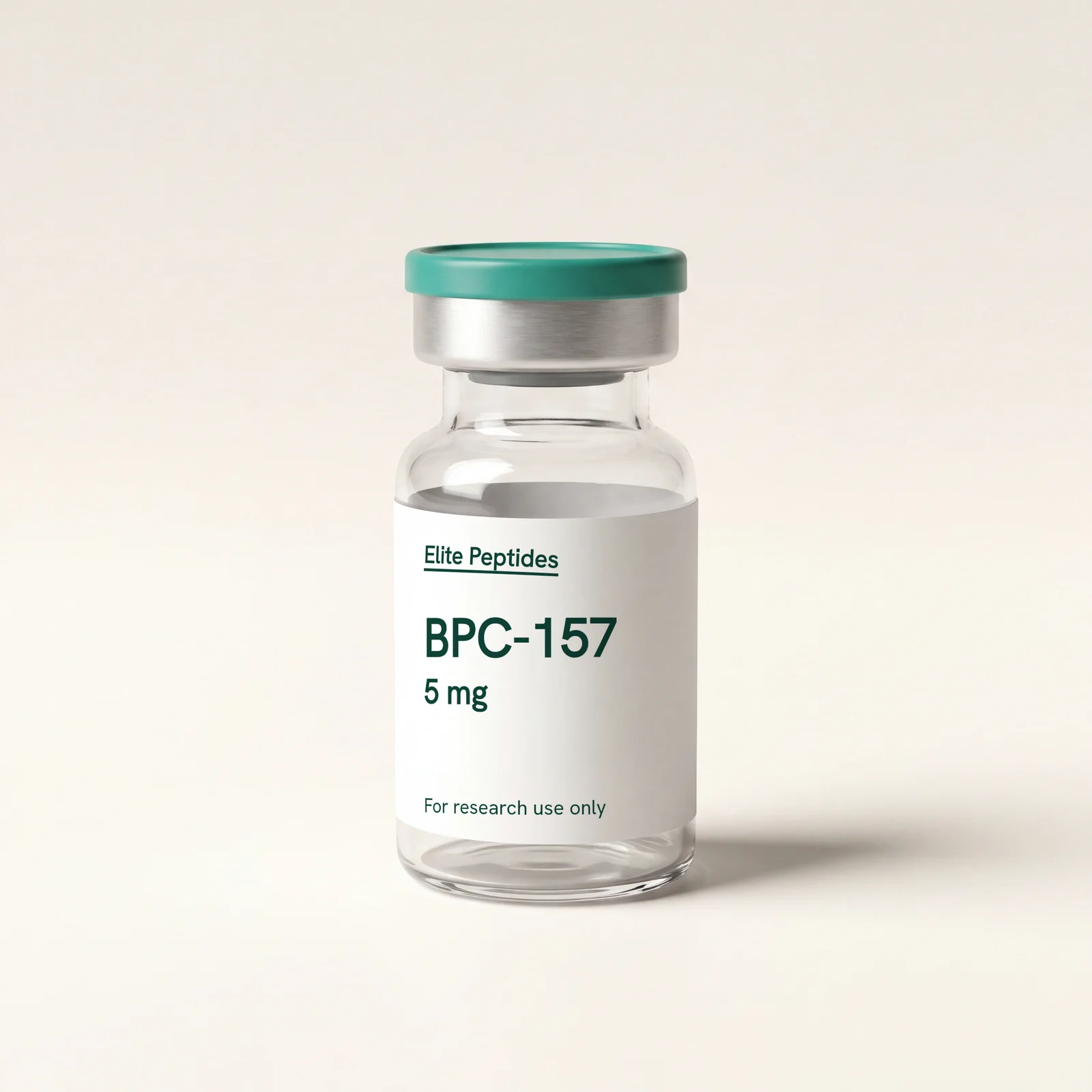
BPC-157 in Australia. BPC-157 is a synthetic 15-amino-acid pentadecapeptide (Body Protective Compound-157) studied across the soft-tissue, tendon, ligament, gastric and angiogenesis research literature — the category benchmark cited in nearly every research-peptide catalogue. This guide is a research-reference summary for Australian researchers. It makes no performance, medical, or human-use claim.
What BPC-157 is
BPC-157 (a 15-residue pentadecapeptide, sequence GEPPPGKPADDAGLV) is a partial sequence derived from research on a stable gastric-juice protective protein. It is one of the most-studied compounds in the research-peptide literature, referenced across tendon and ligament cytoprotection, gastric-mucosal, angiogenic and broader soft-tissue-repair research.
Pathway research on BPC-157
Pathway research on BPC-157 is synthesised in the review by Seiwerth and colleagues (Frontiers in Pharmacology, 2021), which covers its reported interaction with the nitric-oxide system and its VEGFR2-associated angiogenic signalling. The pro-angiogenic mechanism — up-regulation and activation of the VEGFR2–Akt–eNOS axis — was reported by Hsieh and colleagues (Journal of Molecular Medicine, 2017). In tendon-cell research, Chang and colleagues (Journal of Applied Physiology, 2011) linked BPC-157 to tendon-fibroblast outgrowth, survival and migration through the FAK–paxillin pathway. It is studied in vitro as a research tool, not as a treatment.
The canonical TB-500 pairing
BPC-157 is most frequently referenced alongside TB-500 (thymosin β-4) in the canonical “soft-tissue” research pair — the two act on distinct pathways (growth-factor / nitric-oxide signalling versus actin dynamics) that converge on the tissue-repair research model. See the TB-500 research guide for the actin-dynamics partner, or the BPC-157 + TB-500 “Wolverine stack” guide for the co-lyophilised pairing in a single vial.
Identity, purity and the COA moat
Every batch of BPC-157 supplied by Elite AU Peptides is independently HPLC-tested by Janoshik before it is listed. The measured purity is published on the BPC-157 product page and in the lab-reports library — a real batch number, the measured percentage rather than a marketing figure, and an independently verifiable Janoshik report. BPC-157 is stocked in 5mg and 10mg lyophilised vials; nothing is listed without a certificate on file.
Reconstitution, handling and compliance
BPC-157 ships as a lyophilised powder. Reconstitute with bacteriostatic water for laboratory handling — a 5mg vial in 2mL yields a 2.5mg/mL working stock. Store the powder at −20°C protected from light; once reconstituted, refrigerate at 2–8°C and use within the documented research window. BPC-157 is not TGA-approved and is not a therapeutic good; Elite AU Peptides makes no medical, performance, or human-use claim, and supplies it strictly for in-vitro and laboratory research use only. Researchers should consult primary peer-reviewed sources for pathway data.
[ Frequently asked ]
Healing & recovery research — questions researchers ask.
- What is BPC-157?
- BPC-157 is a synthetic 15-amino-acid pentadecapeptide (Body Protective Compound-157) referenced across tendon, ligament, gastric-tissue, soft-tissue and angiogenesis research literature — the category benchmark in healing and recovery research peptides. Elite AU Peptides supplies it strictly for in-vitro and laboratory research use only — not for human or animal consumption, not a therapeutic good, and not TGA-approved. No performance or human-use claim is made about it.
- What research is BPC-157 associated with?
- Pathway research on BPC-157 is synthesised in the review by Seiwerth and colleagues (Frontiers in Pharmacology, 2021), covering its reported interaction with the nitric-oxide system and VEGFR2-associated angiogenic signalling. The pro-angiogenic mechanism (the VEGFR2–Akt–eNOS axis) was reported by Hsieh and colleagues (Journal of Molecular Medicine, 2017), and Chang and colleagues (Journal of Applied Physiology, 2011) linked BPC-157 to tendon-fibroblast outgrowth via the FAK–paxillin pathway. It is studied in vitro as a research tool, not as a treatment.
- How does BPC-157 pair with TB-500?
- BPC-157 and TB-500 (thymosin β-4) are the canonical “soft-tissue” research pair — they act on distinct pathways (growth-factor / nitric-oxide signalling versus actin dynamics) that converge on the tissue-repair research model, so they are frequently referenced together. See the TB-500 guide for the actin-dynamics partner, or the BPC-157 + TB-500 “Wolverine stack” guide for the co-lyophilised pairing.
- Is BPC-157 TGA-approved in Australia?
- No. BPC-157 is not TGA-approved and is not a therapeutic good. It is supplied strictly for in-vitro and laboratory research use only, with no medical, performance, or human-use claim.
- How is research-grade BPC-157 tested?
- Every batch is independently HPLC-tested by Janoshik Analytical before it is listed. The measured purity is published on the product page and in the lab-reports library — a real batch number, the measured percentage, and an independently verifiable Janoshik report; nothing is listed without a certificate on file.
- How is BPC-157 reconstituted and stored for research use?
- The lyophilised vial is reconstituted with bacteriostatic water for laboratory handling — for example, a 5mg vial in 2mL yields a 2.5mg/mL working stock. Store the lyophilised powder at −20°C protected from light; once reconstituted, refrigerate at 2–8°C and use within the documented research window.
- How is BPC-157 shipped in Australia?
- Stock is held and dispatched AU-domestic — no inbound customs handling. Free shipping over $100; orders placed before 12pm AEST are dispatched the same business day. Supplied strictly for laboratory research use only.
[ Referenced in this guide ]
Shop the compounds
- BPC-157 — 5mg / 10mgThe research-grade vial this guide references — independently HPLC-tested, COA on file, AUD pricing.
- TB-500 (Thymosin β-4) — 5mg / 10mgThe peptide BPC-157 is canonically paired with in soft-tissue research.
- BPC-157 + TB-500 research blendThe co-lyophilised “Wolverine” pairing in a single vial.
Comparing suppliers? Peptide prices in Australia lists what every compound and vial size costs in AUD, read live from the catalogue, next to the batch certificate for each one.
[ Keep reading ]
More research guides
- TB-500 (thymosin β-4) research guideThe canonical soft-tissue research partner to BPC-157.
- BPC-157 + TB-500 “Wolverine stack” research guideThe co-lyophilised pairing this compound is half of.
- Healing & Recovery research peptidesThe catalogue category BPC-157 is filed under.
- All research guidesBrowse every research-use guide in the library.
Elite AU Peptides supplies research peptides and related compounds for laboratory and in-vitro research use only. Products are not therapeutic goods, are not TGA-approved, and are not for human or animal consumption. Nothing on this site constitutes medical advice or a therapeutic claim. Purchasers must be 18 years or older and are responsible for complying with all applicable laws in their jurisdiction.