Rated 5 out of 5.Verified purchase
CJC-1295 no DAC 10mg. Quick post, tidy packing, COA matched the vial. No dramas at all.
Shipping 5/5Would recommend
Free shipping Australia-wide on orders over $100
Free shipping over $100 · same-day dispatch before 12pm AEST · Australia only.
Supplied strictly for in-vitro / laboratory research use only. Not for human or animal consumption. You confirm you are 18+ and purchasing for research purposes.
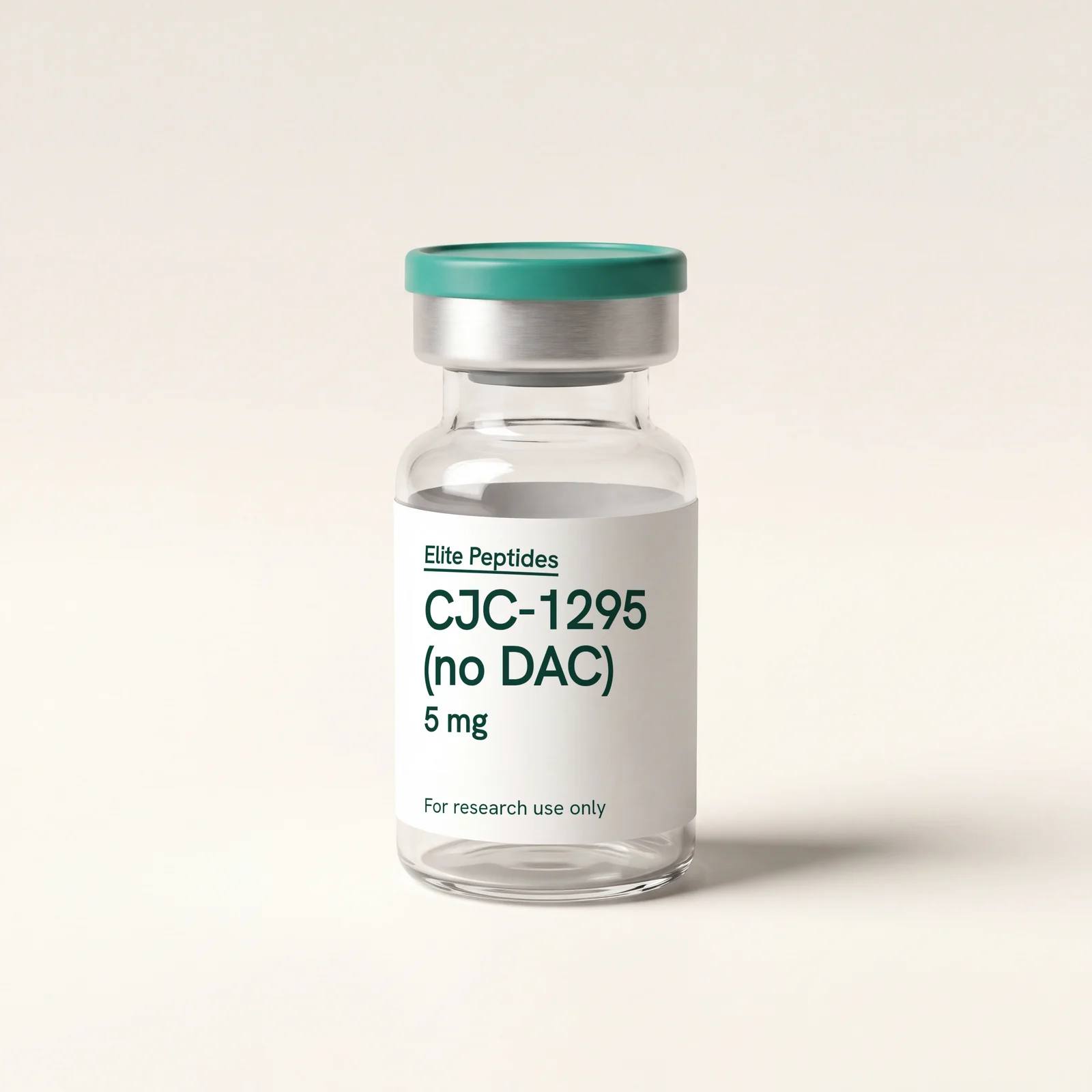
CJC-1295 (no DAC) Australia. This is the standalone GHRH research peptide. The reported outcomes are a bigger growth hormone pulse and the IGF-1 rise that follows it. The reason the no DAC form is the one used in research is that it preserves the body's natural pulsing rhythm rather than flattening it into a constantly raised level, so the work can measure whether restoring a bigger, properly timed pulse changes body composition, recovery and sleep depth.
How it does it. CJC-1295 (no DAC), also sold as Mod GRF (1-29), is a tougher copy of GHRH, the signal the brain sends the pituitary gland to release growth hormone. Natural GHRH is destroyed by an enzyme within a couple of minutes, and swapping a handful of building blocks in the sequence blocks that enzyme. The no DAC part matters when choosing between versions. The DAC variant carries an extra chemical anchor that latches onto blood proteins and keeps it circulating for days, while this one has the stabilised backbone without that anchor.
The vial. Independently HPLC-tested by Janoshik, with the certificate of analysis published on this page and in the lab-reports library, carrying the measured number and a verifiable Janoshik key. Supplied in 5 mg and 10 mg freeze-dried vials, dispatched from Australia, AUD pricing. This is the standalone peptide. The CJC-1295 (no DAC) + Ipamorelin blend is a separate product. Supplied strictly for in-vitro and laboratory research use only. Not for human or animal consumption, not a therapeutic good, not TGA-approved.
Also written cjc1295. CJC1295 without the hyphen, and mod GRF 1-29, both name this vial: the growth-hormone-releasing-hormone analogue WITHOUT the drug affinity complex. If a listing says cjc1295 dac it is the other form, not this one.
CJC-1295 (no DAC) (CAS 863288-34-0; molecular formula C152H252N44O42, average molecular weight ≈ 3368 g/mol) is a 30-residue synthetic analogue of the native hGRF(1-29) sequence — Mod GRF (1-29). It carries four stabilising substitutions on the GHRH(1-29) backbone (including D-Ala at position 2) plus a C-terminal amide, which slow enzymatic degradation while retaining GHRH-receptor-binding activity in research models.
The value of that backbone chemistry is well characterised: Soule and colleagues (The Journal of Clinical Endocrinology & Metabolism, 1994) showed that incorporating D-Ala2 into GHRH(1-29) increases half-life and lowers metabolic clearance by blocking dipeptidyl-peptidase cleavage — the substitution central to the Mod GRF (1-29) backbone.
The "no DAC" label distinguishes this form from the DAC (drug-affinity-complex) variant: Jetté and colleagues (Endocrinology, 2005) identified CJC-1295 as an albumin-bioconjugated hGRF(1-29) analogue with plasma persistence extending over days, and Teichman and colleagues (The Journal of Clinical Endocrinology & Metabolism, 2006) reported the multi-day half-life of that DAC molecule. The no-DAC form referenced here carries the stabilising backbone substitutions but not the albumin-binding DAC group, so it is the shorter-acting, canonical reference version in GHRH research.
In research literature CJC-1295 (no DAC) is most frequently studied alongside a GHRP (typically Ipamorelin) — the canonical research pairing combines a GHRH-analogue and a GHRP because the two receptor classes act on distinct, convergent points of the same somatotrophic-axis research model. See the CJC-1295 (no DAC) + Ipamorelin research blend product page for the co-lyophilised research-stack variant, and the Ipamorelin standalone product page for the GHRP partner.
The information provided here is a research-reference summary only. Elite AU Peptides makes no medical, therapeutic, performance, or human-use claim about this product. CJC-1295 (no DAC) is not TGA-approved, is not a therapeutic good, and is supplied strictly for in-vitro and laboratory research use only. Researchers should consult the primary peer-reviewed literature for receptor-binding affinities, pharmacokinetic data, and protocol-specific reference values.
Reconstitute the lyophilised CJC-1295 (no DAC) vial with bacteriostatic water for laboratory handling. Add the diluent slowly down the vial wall and swirl gently rather than shaking. The required volume depends on the protocol’s downstream assay requirements — a 5 mg vial reconstituted in 2.5 mL of bacteriostatic water yields a 2 mg/mL working stock. Adjust per protocol.
Store the lyophilised powder at −20°C, desiccated and protected from light; once reconstituted, store refrigerated at 2–8°C and use within the documented research window, or aliquot and freeze to avoid repeated freeze-thaw cycles. Tamper-evident packaging; the batch label is the canonical reference for the certificate of analysis published in the lab-reports library.
Australia only. Free shipping over $100. Orders placed before 12pm AEST are dispatched the same business day from Australia.
30-day returns on unused product in original packaging, with prior approval.
[ Further reading ]
CJC-1295 in Australia: a GHRH-analogue research guideWhat CJC-1295 (no DAC) is — a stabilised 30-residue GHRH analogue, also catalogued as Mod GRF (1-29) — the difference between the DAC and no-DAC forms, where it sits in growth-hormone-secretagogue research, and how research-grade material is HPLC-verified. A laboratory research reference for Australian researchers.
[ Certificate of analysis ]
— The batch certificate and downloadable scan for CJC-1295 are published on the lab-reports page and confirmed at catalogue load.
Janoshik · HPLC
≥ 99%
brand standard · independently verified
[ Customer reviews ]
5.0
Average rating 5 out of 5, from 1 review
CJC-1295 no DAC 10mg. Quick post, tidy packing, COA matched the vial. No dramas at all.
[ Stacked with ]
[ Related products ]
Compare this against every other vial on the peptide prices page, browse gh secretagogues, or see all 23 research peptides.
Elite AU Peptides supplies research peptides and related compounds for laboratory and in-vitro research use only. Products are not therapeutic goods, are not TGA-approved, and are not for human or animal consumption. Nothing on this site constitutes medical advice or a therapeutic claim. Purchasers must be 18 years or older and are responsible for complying with all applicable laws in their jurisdiction.